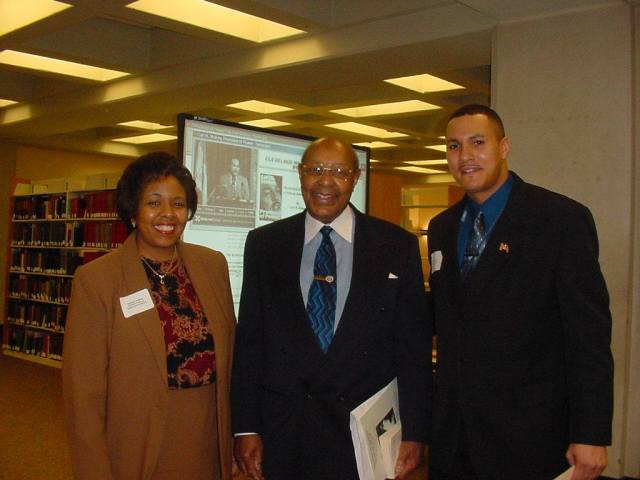
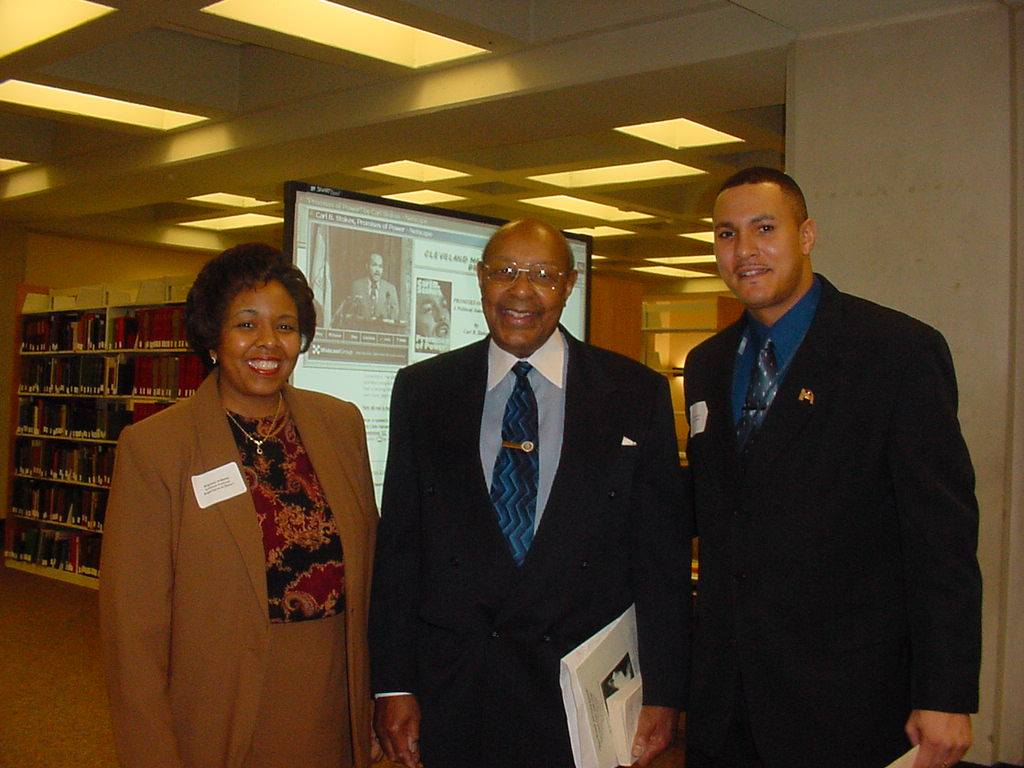
Pictured here are (left to right) Regennia N. Williams, Congressman Louis Stokes, and Cordell Stokes (c. 2002) at Cleveland State University, Library Special Collections. (Photo courtesy Bill Barrow.)
This has really been a tough week for those of who love American history and the people who make it. Before we recovered from the shock of losing Professor Julian Bond, we discovered that Congressman Louis Stokes had passed on.
In times like these, I find myself searching for just the right piece of primary evidence to take away some of the pain and feelings of loss, and to remind me of how incredibly wonderful life can be. (I can’t help it; I guess it’s just the historian in me!)
Earlier this week, I searched in vain for a copy of a Cleveland State University Library newsletter that is more than 10 years old, because I needed to see a special photo containing the smiling face of Congressman Louis Stokes. I never found the newsletter, but I did find the image on Facebook today! Not only did I get to see the Congressman’s smile, I also saw another beautiful smile on the face of the Congressman’s nephew, Cordell Stokes. Until today, I never noticed how much Cordell’s smile resembled that of his late father, Mayor Carl B. Stokes.
So here’s to life, here’s to the infectious smiles of the Stokes brothers, and here’s to Bill Barrow, creator of the Cleveland Memory digital archive. In case you didn’t see his image on Facebook, here is what I said about Bill’s post:
Even when our hearts are heavy, Bill Barrow has a way of reminding us of why CSU’s Library Special Collections are so special! Thanks, again, Bill, for sharing this photo (c. 2002) of me with Congressman Louis Stokes and Cordell Stokes, son of Mayor Carl Stokes. I will miss the Stokes brothers, but I cannot forget their social and political accomplishments — and their smiles!

About Dr. Regennia N. Williams, Founder, President, and Executive Director
Dr. Regennia N. Williams is the Founder and Executive Director of The RASHAD Center, Inc., a Maryland-based non-profit educational corporation.
Williams holds a PhD in Social History and Policy from Case Western Reserve University in Cleveland, Ohio. A native Clevelander and a four-time alumna of Cleveland State University, information on RASHAD's “Praying Grounds, African American Faith Communities: A Documentary and Oral History” project is now available online at www.ClevelandMemory.org/pray/, a site that is maintained by CSU's Library Special Collections, home of the Praying Grounds manuscript collections. Praying Grounds was the primary inspiration for the launching of the Initiative for the Study of Religion and Spirituality in the History of Africa and the Diaspora (RASHAD) at CSU, and links to RASHAD's scholarly journal and newsletter are also available on the Praying Grounds site. On April 28, 2020, the RASHAD Center, Inc. became a tax-exempt 501(c)(3) nonprofit organization.
In 2010, Dr. Williams was a Visiting Fulbright Scholar at Nigeria’s Obafemi Awolowo University, where she taught history and directed a RASHAD-related oral history project that focused on the role of religion in recent Nigerian social history. Other research-related travels have taken her to Canada, China, France, South Africa, and Austria.
In 2013, she conceived and produced “Come Sunday @ 70: The Place of Duke Ellington’s Sacred Jazz in World History and Culture, c. 1943-2013,” a project that included scholarly presentations and performing arts activities. From September 1993 until May 2015, she was a faculty member in the Department of History at Cleveland State University. She served as a Fulbright Specialist at South Africa's University of the Free State in the summer of 2019, and completed a short-term faculty residency at Howard University in the fall of 2019. She is based in Cleveland, Ohio.
As a public scholar, her current research projects focus on African American history and culture, especially as it relates to music, religion, and spirituality. She is a member of the Oral History Association, the Western Reserve Historical Society, and the National Museum of African American History and Culture.


 The RASHAD Center, Inc.