
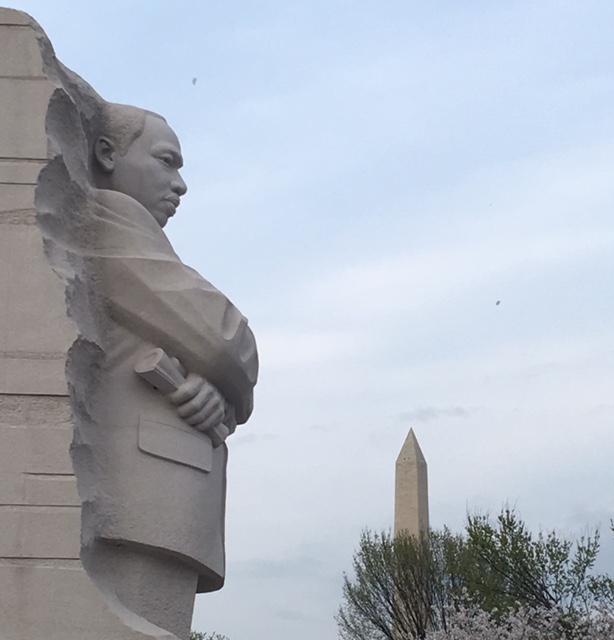
The Rev. Dr. Martin Luther King, Jr. Memorial and the Washington Monument, 2016.
CALL FOR SUBMISSIONS
The Revolution Is Now Being Televised and Tweeted:
Black Protest, Preaching, and (Re)Presentations,
From the Black Arts Movement to #BlackLivesMatter, c.1965-2016
for
The Journal of Traditions & Beliefs
Spring 2017
Regennia N. Williams, PhD, Editor
The revolution will not be televised, will not be televised,
Will not be televised, will not be televised.
The revolution will be no re-run brothers;
The revolution will be live.
— Gil Scott-Heron, 1970
The assassination of El Hajj Malik El Shabazz (Malcolm X)—and the related rise in Black Nationalism, Amiri Baraka’s founding of the Black Arts Repertory Theatre/School, the Rev. Dr. Martin Luther King, Jr.’s leadership role in the Selma to Montgomery March, the passage of the Voting Rights Act, the world premiere of Duke Ellington’s Sacred Concert, and other bold experiments in music, visual arts, and literature are all associated with 1965. In the history of a decade characterized by seismic shifts in Black thought, 1965 marked a watershed, and the revolutionary spirit of that year continued beyond the 1960s.
The Journal of Traditions & Beliefs (JTB) invites submissions for its Spring 2017 issue, The Revolution Is Now Being Televised and Tweeted: Black Protest, Preaching, and Cultural (Re)Presentations, From the Black Arts Movement to #BlackLivesMatter, c.1965-2016. Publishable manuscripts will reflect scholars’ and artists’ diverse viewpoints on the evolving role of various religious, spiritual, and cultural traditions in the digital age—especially when considered in relationship to Black church history, political thought, the arts (including the legacies of Amiri Baraka and Gil Scott-Heron), and ongoing debates about education, human rights, and social justice.
JTB, a peer-reviewed open access journal, publishes scholarly articles, essays, creative writing, book reviews, and K-12 curriculum materials. Manuscripts for articles and essays should be typewritten, single-spaced, no more than 15 pages in length (including Turabian-style footnotes and bibliography), and prepared using A Manual for Writers of Research Papers, Theses, and Dissertations (University of Chicago Press, 7th Edition or later). Poems, book reviews, and the introductions to lesson plans should not exceed 750 words.
For consideration, please submit all manuscripts by October 15, 2016 via the journal’s official website, http://engagedscholarship.csuohio.edu/jtb/ (The creation of a password protected account is required.) Authors will be notified of final decisions by December 15, 2016.
If you are interested in writing a book review or have other questions or concerns, please review the information in the “Policies” section of the JTB website, and contact Dr. Regennia N. Williams at regennia@gmail.com.


 The RASHAD Center, Inc.