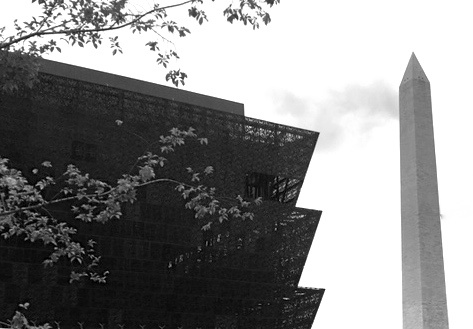
The National Museum of African American History and Culture and the Washington Monument.
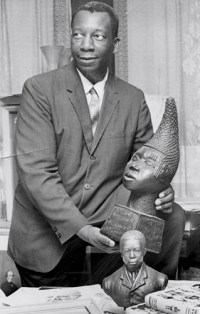
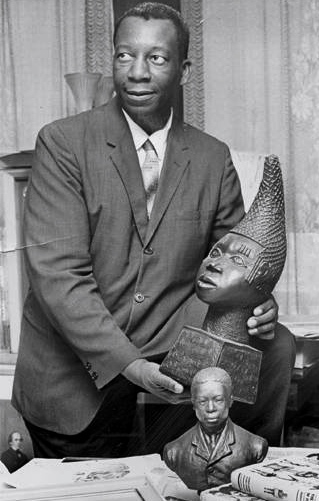
Icabod Flewellen, 1964 (Cleveland Press Collection, CSU) .
As we prepare for the annual celebrations of the life and legacy of the Rev. Dr. Martin Luther King, Jr. and African American History Month, I want to believe that Icabod Flewellen, the son of an African Methodist Episcopal (AME) pastor, and founder of Cleveland, Ohio’s Afro-American Cultural & Historical Society in 1953, would be pleased with the progress that we as a nation have made–at least as far as race relations are concerned. After all, the United States elected its first African American president in 2008, and, in 2016, President Barack Hussein Obama helped dedicate the National Museum of African American History and Culture, when it opened on the Mall, the site of the historic 1963 March on Washington.
I suspect, however, that, as a veteran of many struggles, Flewellen might also remind us that, as Frederick Douglass –another member of the AME Church–often suggested, securing and protecting real progress in a free country requires continuous struggle:
“If there is no struggle, there is no progress. Those who profess to favor freedom, and yet depreciate agitation, are men who want crops without plowing up the ground. They want rain without thunder and lightning. They want the ocean without the awful roar of its many waters. This struggle may be a moral one; or it may be a physical one; or it may be both moral and physical; but it must be a struggle. Power concedes nothing without a demand. It never did and it never will.”
Save
“Tis always the season to understand our history.
Save
Save
Save
Save
Save
Save
Save

About Dr. Regennia N. Williams, Founder, President, and Executive Director
Dr. Regennia N. Williams is the Founder and Executive Director of The RASHAD Center, Inc., a Maryland-based non-profit educational corporation.
Williams holds a PhD in Social History and Policy from Case Western Reserve University in Cleveland, Ohio. A native Clevelander and a four-time alumna of Cleveland State University, information on RASHAD's “Praying Grounds, African American Faith Communities: A Documentary and Oral History” project is now available online at www.ClevelandMemory.org/pray/, a site that is maintained by CSU's Library Special Collections, home of the Praying Grounds manuscript collections. Praying Grounds was the primary inspiration for the launching of the Initiative for the Study of Religion and Spirituality in the History of Africa and the Diaspora (RASHAD) at CSU, and links to RASHAD's scholarly journal and newsletter are also available on the Praying Grounds site. On April 28, 2020, the RASHAD Center, Inc. became a tax-exempt 501(c)(3) nonprofit organization.
In 2010, Dr. Williams was a Visiting Fulbright Scholar at Nigeria’s Obafemi Awolowo University, where she taught history and directed a RASHAD-related oral history project that focused on the role of religion in recent Nigerian social history. Other research-related travels have taken her to Canada, China, France, South Africa, and Austria.
In 2013, she conceived and produced “Come Sunday @ 70: The Place of Duke Ellington’s Sacred Jazz in World History and Culture, c. 1943-2013,” a project that included scholarly presentations and performing arts activities. From September 1993 until May 2015, she was a faculty member in the Department of History at Cleveland State University. She served as a Fulbright Specialist at South Africa's University of the Free State in the summer of 2019, and completed a short-term faculty residency at Howard University in the fall of 2019. She is based in Cleveland, Ohio.
As a public scholar, her current research projects focus on African American history and culture, especially as it relates to music, religion, and spirituality. She is a member of the Oral History Association, the Western Reserve Historical Society, and the National Museum of African American History and Culture.


 The RASHAD Center, Inc.