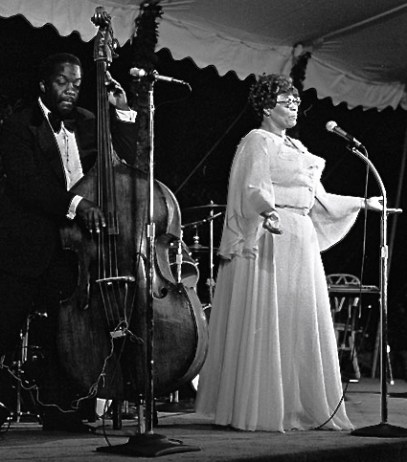
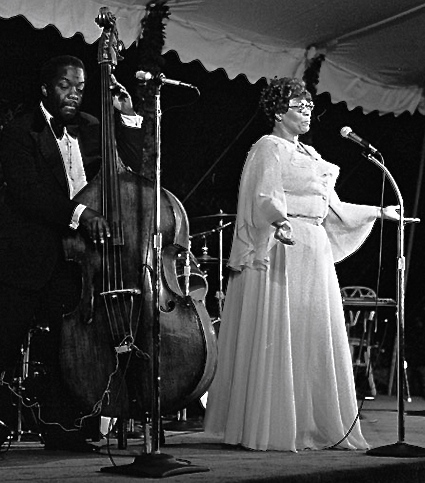
Keter Betts and Ella Fitgerald (Courtesy Gerald R. Ford Library)
The summer of 2017 has been a wonderful season of teaching and learning for me, especially when it comes to those lessons about outstanding musicians. The music of bassist Keter Betts (1928-2005), for example, continues to provide abundant evidence of the versatility of African American jazz artists and their willingness to share their gifts with and learn from other artists. As a relative newcomer to the mid-Atlantic region, I also like knowing that Betts’ family has ties to Maryland’s Montgomery College, where I am teaching a course on “The Jazz Age and the Harlem Renaissance.”
Betts, a native of New York state and a longtime resident of Maryland, is proving to be my go-to bassist for course-related evidence of the rich legacy of the early 20th-century Jazz Age and musical innovations that were introduced to American audiences in subsequent decades–including those associated with Betts’ work with guitarist Charlie Byrd on the Brazilian-inspired “Jazz Samba” and the related growth in the popularity of bossa nova.
I recently invited my Montgomery College students and readers of this blog to listen to a 1986 performance of Dizzy Gillespie’s “A Night in Tunisia,” featuring Keter Betts and Ella Fitzgerald. Today, I would like to share yet another example of the artists’ mastery of improvisation and their playful (and somewhat unorthodox) use of “call and response” in yet another live performance: https://www.youtube.com/watch?v=uKNgAAaoD_E
No wonder Keter and Ella are two of my favorite teachers!
Regennia N. Williams, PhD
Save
Save
Save
Save
Save
Save
Save
Save
Save

About Dr. Regennia N. Williams, Founder, President, and Executive Director
Dr. Regennia N. Williams is the Founder and Executive Director of The RASHAD Center, Inc., a Maryland-based non-profit educational corporation.
Williams holds a PhD in Social History and Policy from Case Western Reserve University in Cleveland, Ohio. A native Clevelander and a four-time alumna of Cleveland State University, information on RASHAD's “Praying Grounds, African American Faith Communities: A Documentary and Oral History” project is now available online at www.ClevelandMemory.org/pray/, a site that is maintained by CSU's Library Special Collections, home of the Praying Grounds manuscript collections. Praying Grounds was the primary inspiration for the launching of the Initiative for the Study of Religion and Spirituality in the History of Africa and the Diaspora (RASHAD) at CSU, and links to RASHAD's scholarly journal and newsletter are also available on the Praying Grounds site. On April 28, 2020, the RASHAD Center, Inc. became a tax-exempt 501(c)(3) nonprofit organization.
In 2010, Dr. Williams was a Visiting Fulbright Scholar at Nigeria’s Obafemi Awolowo University, where she taught history and directed a RASHAD-related oral history project that focused on the role of religion in recent Nigerian social history. Other research-related travels have taken her to Canada, China, France, South Africa, and Austria.
In 2013, she conceived and produced “Come Sunday @ 70: The Place of Duke Ellington’s Sacred Jazz in World History and Culture, c. 1943-2013,” a project that included scholarly presentations and performing arts activities. From September 1993 until May 2015, she was a faculty member in the Department of History at Cleveland State University. She served as a Fulbright Specialist at South Africa's University of the Free State in the summer of 2019, and completed a short-term faculty residency at Howard University in the fall of 2019. She is based in Cleveland, Ohio.
As a public scholar, her current research projects focus on African American history and culture, especially as it relates to music, religion, and spirituality. She is a member of the Oral History Association, the Western Reserve Historical Society, and the National Museum of African American History and Culture.


 The RASHAD Center, Inc.