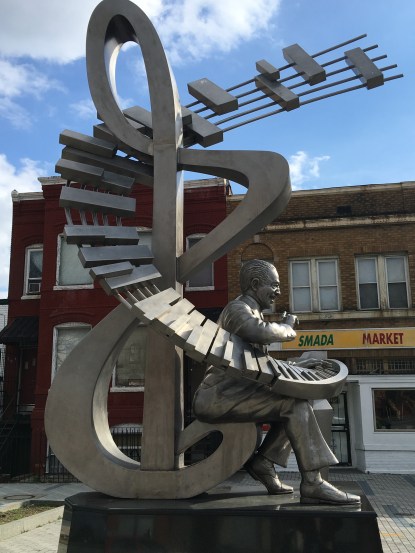
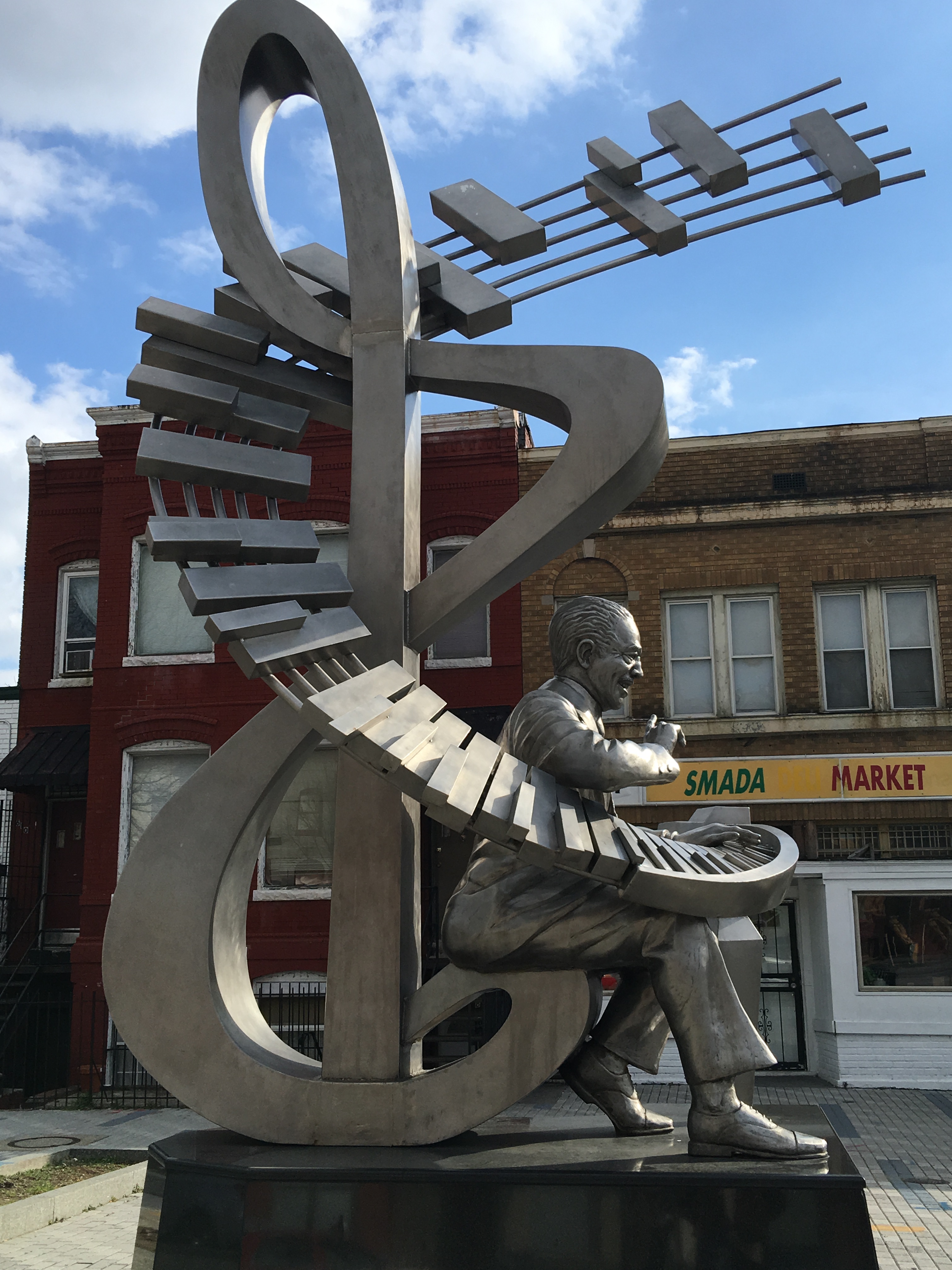
Titled “Encore,” this statue of native Washingtonian and jazz legend Duke Ellington is now a familiar landmark in the historic Shaw-Howard Community. Like many supporters of the DC Living Heritage Network, Ellington explored the linkages between the arts, humanities, and business–often while living in Shaw and/or working in the Greater U Street Corridor.
In the short time that I have been aware of and actively participating in the small group meetings of the DC Living Heritage Network (DCLHN), I have come to appreciate the vital role that creative thinkers play in both the non-profit and for-profit sectors.
A program of Humanities DC, DCLHN is “an active community of cultural advocates that believes in inclusion, collaboration, and capacity building for organizations and individuals supporting the humanities, heritage, and preservation.”
Facilitated by Jerome S. Paige, the group sessions are held at 11:30 a.m. on Tuesdays, at the Mulebone Restaurant in the Greater U Street Corrider, home to “Black Broadway” and numerous jazz venues in the early 20th century.
Summer 2017 discussions have included such topics as “Writing Business Plans,” “Social Media and Marketing,” and “Building the Strength of Your Brand through Relationships.” Among those who attend on a regular basis are visual artists, directors of performing arts organizations, humanities scholars, educators, and representatives from Humanities DC.
Most recently, Gina Paige, founder of African Ancestry, a company that focuses on African DNA lineage tracing, served as the guest speaker. Launched in 2003, Paige describes her company as an “identity business.”
And what does this for-profit busines that relies so much on the science of genetics have to do with humanities, heritage, and preservation? For me, the answer can be found in Paige’s statement about the significance of African Ancestry’s heritage-related work: “Knowing where you are from is an important part of knowing who you are.”
For more information on the DC Living Heritage Network, visit http://www.wdchumanities.org/dc-living-heritage-network/.
Save
Save
Save
Save
Save
Save
Save
Save
Save
Save
Save

About Dr. Regennia N. Williams, Founder, President, and Executive Director
Dr. Regennia N. Williams is the Founder and Executive Director of The RASHAD Center, Inc., a Maryland-based non-profit educational corporation.
Williams holds a PhD in Social History and Policy from Case Western Reserve University in Cleveland, Ohio. A native Clevelander and a four-time alumna of Cleveland State University, information on RASHAD's “Praying Grounds, African American Faith Communities: A Documentary and Oral History” project is now available online at www.ClevelandMemory.org/pray/, a site that is maintained by CSU's Library Special Collections, home of the Praying Grounds manuscript collections. Praying Grounds was the primary inspiration for the launching of the Initiative for the Study of Religion and Spirituality in the History of Africa and the Diaspora (RASHAD) at CSU, and links to RASHAD's scholarly journal and newsletter are also available on the Praying Grounds site. On April 28, 2020, the RASHAD Center, Inc. became a tax-exempt 501(c)(3) nonprofit organization.
In 2010, Dr. Williams was a Visiting Fulbright Scholar at Nigeria’s Obafemi Awolowo University, where she taught history and directed a RASHAD-related oral history project that focused on the role of religion in recent Nigerian social history. Other research-related travels have taken her to Canada, China, France, South Africa, and Austria.
In 2013, she conceived and produced “Come Sunday @ 70: The Place of Duke Ellington’s Sacred Jazz in World History and Culture, c. 1943-2013,” a project that included scholarly presentations and performing arts activities. From September 1993 until May 2015, she was a faculty member in the Department of History at Cleveland State University. She served as a Fulbright Specialist at South Africa's University of the Free State in the summer of 2019, and completed a short-term faculty residency at Howard University in the fall of 2019. She is based in Cleveland, Ohio.
As a public scholar, her current research projects focus on African American history and culture, especially as it relates to music, religion, and spirituality. She is a member of the Oral History Association, the Western Reserve Historical Society, and the National Museum of African American History and Culture.



 The RASHAD Center, Inc.