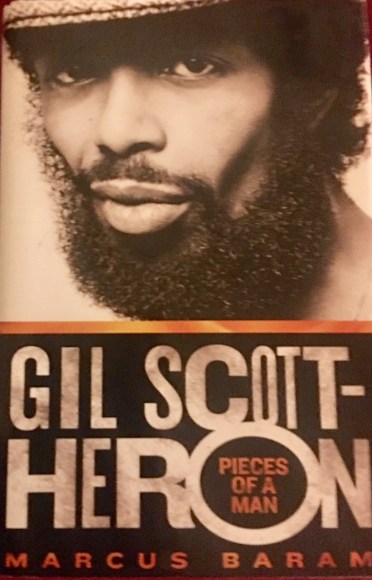
 The more I learn about Gil Scott-Heron, the more I admire him. I have long been familiar with his work as a poet, pianist, composer, spoken word artist, and the youthful voice of Black protest in the 20th century. It was not until 2017, however, that I discovered how much he had in common with another great writer, Langston Hughes.
Born nearly five decades apart, both Hughes (1902-1967) and Scott-Heron (1949-2011) gained a large readership/listening audience while they were students at Pennsylvania’s Lincoln University. In their heyday, each man’s work was seen as part of a larger cultural movement; the Harlem Renaissance of the 1920s for Hughes, and the Black Arts Movement of the 1970s for Scott-Heron.
Both men also made liberal use of blues traditions in their work. The Weary Blues (1926), for example, was Hughes’ first published volume of poetry. In The Life of Langston Hughes, biographer Arnold Rampersad even described Hughes as the “little brown poet of the blues.”
For his part, Scott-Heron was a self-described “bluesologist,” and, according to Marcus Baram, author of Gil Scott-Heron: Pieces of a Man, “He actually coveted any comparison with Hughes, when critics made the reference in their reviews.” This blog post is not a review, but I am making the reference. Hughes and Scott-Heron remind me of each other, in more ways than I can mention here.
Please join me in celebrating the blues in the art and life stories of Hughes and Scott-Heron during Black History Month 2018. Even if you don’t get to read their work in February, remember great art is always in vogue! –RNW

About Dr. Regennia N. Williams, Founder, President, and Executive Director
Dr. Regennia N. Williams is the Founder and Executive Director of The RASHAD Center, Inc., a Maryland-based non-profit educational corporation.
Williams holds a PhD in Social History and Policy from Case Western Reserve University in Cleveland, Ohio. A native Clevelander and a four-time alumna of Cleveland State University, information on RASHAD's “Praying Grounds, African American Faith Communities: A Documentary and Oral History” project is now available online at www.ClevelandMemory.org/pray/, a site that is maintained by CSU's Library Special Collections, home of the Praying Grounds manuscript collections. Praying Grounds was the primary inspiration for the launching of the Initiative for the Study of Religion and Spirituality in the History of Africa and the Diaspora (RASHAD) at CSU, and links to RASHAD's scholarly journal and newsletter are also available on the Praying Grounds site. On April 28, 2020, the RASHAD Center, Inc. became a tax-exempt 501(c)(3) nonprofit organization.
In 2010, Dr. Williams was a Visiting Fulbright Scholar at Nigeria’s Obafemi Awolowo University, where she taught history and directed a RASHAD-related oral history project that focused on the role of religion in recent Nigerian social history. Other research-related travels have taken her to Canada, China, France, South Africa, and Austria.
In 2013, she conceived and produced “Come Sunday @ 70: The Place of Duke Ellington’s Sacred Jazz in World History and Culture, c. 1943-2013,” a project that included scholarly presentations and performing arts activities. From September 1993 until May 2015, she was a faculty member in the Department of History at Cleveland State University. She served as a Fulbright Specialist at South Africa's University of the Free State in the summer of 2019, and completed a short-term faculty residency at Howard University in the fall of 2019. She is based in Cleveland, Ohio.
As a public scholar, her current research projects focus on African American history and culture, especially as it relates to music, religion, and spirituality. She is a member of the Oral History Association, the Western Reserve Historical Society, and the National Museum of African American History and Culture.


 The RASHAD Center, Inc.