“There is always lots of room for education, pr, and talking about the Howard Theatre and its importance, because it is the oldest major theatre for African American entertainment in the country, older than the Apollo by 25 years.” -–Roy “Chip” Ellis
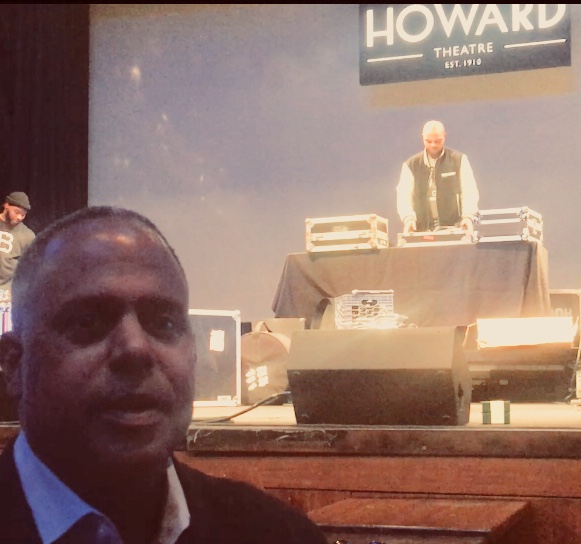
ROY “CHIP” ELLIS — of the Ellis Development Group and the Howard Theatre Development Group– discussed family ties and business ties to Washington DC’s historic Shaw-Howard Community.
“We came upon the Howard Theatre back in 2005. I was developing the property next door, the Progression Place project, that currently houses the United Negro College Fund. In the same square block sat the Howard Theatre. I really felt as if it was important that the Howard be brought back. If we were going to do this large, mixed-use development next door, we needed to have something that would attract people back to this very historic square block called Seventh and T. ”
“Seventh and T is, for Washingtonians, a very famous place. Not only was it a great meeting place in the area, but it was also where the Howard Theatre sat since 1910. So, I knew it was very important. People had tried many, many times to restore the Howard Theatre, but it lay dormant for almost 35 years, until myself and my partner, Malik Ellis, came and decided that we wanted to restore the Historic Howard Theatre . . .”
“I am a fourth generation Washingtonian. My father grew up in this neighborhood. He actually grew up at 9th and P, between 9th and 10th, actually, on P Street. My great grandfather came here with an opportunity to run his brother’s or his cousin’s restaurant that was here on 9th Street back, probably, in the early 1920s. So, my great grandfather and great grandmother came here and lived on 9th Street, and they had a place called the Eureka Café Below. So, they lived above and had a café below.”
“My great grandfather went to Armstrong High School. My father went to Cleveland Elementary, and then he went on to Dunbar High School. He would tell me stories about coming to see acts at the Howard Theatre when he was a young guy.”
“He would always tell me about how he would see Lionel Hampton here, and how many of the people that came to see Lionel, once he started playing the song ‘Flying Home,’ people would, literally, jump out of the balcony area, these balcony areas that you see here [pointing to the seating areas just above the stage], would literally jump off and on to the stage. I always wondered, “How in the world did they do that?” But, he said they would, literally, jump from the balcony to the stage and just start dancing when he would play ‘Flying Home.'”
“[My father lived] very close to Shiloh [Baptist Church], just, probably, four blocks from here. Like I said, my father went to Cleveland Elementary. My great grandparents had the Eureka Café on 9th. He would go there, get his Coca Cola, and then would come over here—potentially, to the Dunbar Theatre, and see what he used to call a “shoot ‘em up.” I guess they had cowboy and Indian movies at the Dunbar. I guess, when he got a little older he attended the Howard Theatre . . .”
*ON GENTRIFICATION AND PRESERVING THE OLD WHILE WELCOMING THE NEW
“I think it’s working. It was very critical for Malik and I, when we decided to take on the Howard Theatre, to have a nonprofit that would be around the Howard Theatre and would ensure that the music was always preserved, the history was preserved, the building’s exterior was preserved, and so that it could also educate the younger generations– and the older generations that may not be from here, about the importance of the Howard Theatre. . .”
Interview Date: May 9, 2017
All Interviews Conducted, Recorded, and Reviewed by
Dr. Regennia N. Williams
Life Member, Oral History Association
Founder and Director, The RASHAD Center, Inc.
For more information, please visit: https://rashadcenter.wordpress.com/.
*Photograph (Still from Oral History Video) Courtesy of Dr. Regennia N. Williams
Lionel Hampton’s “Flying Home”
#WashingtonDCJazz
#DCLegendaryMusicians
#OralHistoryRock


 The RASHAD Center, Inc.