
“In high school, I was listening to drummers like Cozy Cole, Ed Thigpen, Max Roach, Buddy Rich, and Art Blakey . . . My mentor to this very day is Harold Jones.” — Manuel Kellough
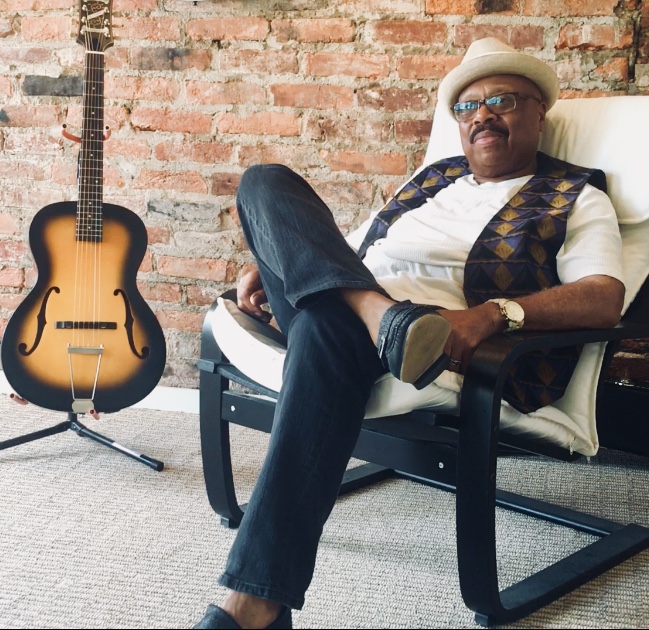
Manuel Kellough, Master Drummer
MANUEL “MANNY” / “THE DEACON” KELLOUGH – a native of Los Angeles, California, is a master drummer and a member of DC Legendary Musicians, Inc. With roots in the Gospel music of LA’s Baptist Church community and branches in just about every other musical genre, Kellough is the recipient of four gold records for work with Billy Preston, a gold album for work with Larry Graham and Graham Central Station, two Grammy Awards for work with Billy Preston, and a Grammy nomination for work with Larry Graham. An alumnus of the University of Southern California, he recently celebrated 56 years as a professional musician. From his first professional public performance outside the church at the age of 13 through his current gig running the Jazz Department for Royal Caribbean Cruise Lines, he has traveled the world, and he says he is still watching, listening, and learning. During his May 2, 2017 interview for the Washington DC Jazz Oral History Project, Manny discussed his family, his career, and an important lesson that he learned from Ray Charles.
“I started playing drums at the tender age of eight years old at the Pleasant Hill Baptist Church in Los Angeles, California . . . It’s funny, because I did not even know that I could play drums. It was just something that I knew I wanted to do. I used to sit and watch Deacon Avery play. I never will forget, I would watch him play every Sunday. I would say, ‘Deacon Avery, I want to play the drums! Can I play the drums?’”
“I guess he got tired of me asking him. One Sunday he told me, ‘Come on up here young fella and play.’ So, I sat down. From watching him every Sunday, I just started doing what he was doing . . . Just watching . . . and to this very day, I watch.”
“That was the norm (having the drums in church). It wasn’t a full drum set. It was the bass drum and the snare drum. That’s all it was. There were no cymbals. It was just being able to sit down and play that beat (demonstrating with hands and feet). That beat would work forever–on any song!”
“Growing up, I listened to a lot of different drummers. In high school, I was listening to drummers like Cozy Cole, Ed Thigpen, Max Roach, Buddy Rich, Art Blakey, and my mentor to this very day is Harold Jones. He’s Tony Bennett’s drummer. I started listening to Harold Jones back in my high school days, when he was with Count Basie.”
“ . . . Vocalists love the way I play, because I am not in their way. I love for them to have the freedom to do whatever they want . . . My style of playing is, ‘Less is always more.’ Play, but not play. Never be in the way . . .I don’t have to have a solo every time. Me, personally, I don’t even like solos . . . I love being an accompanist. I love to swing. Brush work, swinging, things like that . . .”
“I don’t need to be the one out front. Ray Charles told me that one year. I played with Ray Charles when I was like 17 years old. Scared to death. We had a little high school band called Rhythm Rebellion that Ray Charles used to manage. He took us out on the road for exposure. He took us under his wing. I will never forget we were in Cherry Hill, New Jersey–at the Latin Casino, and Ray’s Drummer got sick on a Friday night. So, who else was there to jump right in the pit at the last minute? Manny!
So, here I am scared to death. You’d sit right behind him. You’d sit right in Ray’s ear all the time. You [couldn’t] play too loud, and you [couldn’t] be overpowering. So, I’m sitting there playing. I’m getting excited, a little cocky drummer, 17! I had my cymbals nine feet in the air . . . Then I would jump up and hit the cymbals . . . BAM! So, he turned around and said, ‘Uh, wait a minute, baby, this is not your show. One day, your name will be on the marquee, and it will be your show, but, until then, darling, wait your turn.’ . . .That allowed me to grow up, as a drummer . . . from being a boy to being a man.
Interview Date: May 2, 2017
All Interviews Conducted, Recorded, and Reviewed by
Dr. Regennia N. Williams
Life Member, Oral History Association
Founder and Director, The RASHAD Center, Inc.
For more information, please visit: https://rashadcenter.wordpress.com/.
*Photograph (Still from Oral History Video, Shot at Gibson Guitar, Inc.) Courtesy of Dr. Regennia N. Williams
Drummer Manny Kellough All Stars
#WashingtonDCJazz
#DCLegendaryMusicians
#OralHistoryRocks


 The RASHAD Center, Inc.