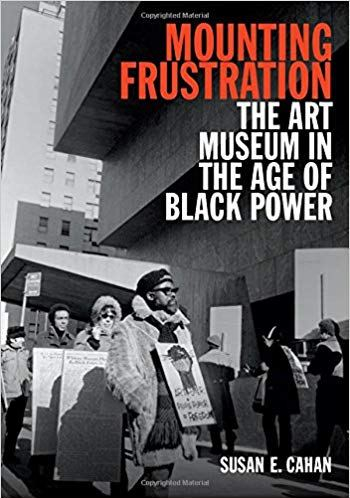
Susan E. Cahan’s Mounting Frustration: The Art Museum in the Age of Black Power examines underrepresented artists’ struggles for visibility and inclusion in New York’s museums and galleries and the mainstream art world in general.
For reasons that make perfectly good sense to me as a teacher-scholar, the 2010s have felt like the “Era of 50th Anniversaries.” The 1960 election of John Fitzgerald Kennedy as the youngest and first Roman Catholic president of the United States, the 1963 March on Washington, the Civil Rights Act of 1964, the Voting Rights Act of 1965, and so many other milestone events from the 1960s have been at the center of countless museum exhibitions, commemorative programs, and songs in recent years.
The title of this post, as jazz fans know, is taken from one of the tracks on “Water,” the 2010 debut album for vocalist Greg Porter. Currently, Washington, DC’s Newseum, is hosting (through January 2, 2019) the “1968: Civil Rights at 50” exhibition. As the description suggests, those viewing the exhibition can, “Explore the events that marked 1968 as a year of anguish for the civil rights movement: the assassinations of the Rev. Dr. Martin Luther King, Jr. and Sen. Robert Kennedy, and a Black Power Protest at the Olympics in Mexico City.”
Information on all of the aforementioned topics is readily available in college-level U.S. history texts that I have used in my classes over the years. By comparison, however, those same required texts have said very about the 1960s as a watershed period for arts activists who wanted to work with mainstream museums to get their work shown and/or to serve as curators or administrators in those institutions. Those activists were not the separatist artists of the Black Arts Movement, who often receive more attention in textbooks.
In order to gain a better understanding of the relationship of arts activism, the Black Arts Movement, the Free Speech Movement in the social history of New York City, and the mainstream Civil Rights Movement in America –and to identify new materials for teaching and research purposes, I decided to read Susan E. Cahan’s Mounting Frustration: The Art Museum in the Age of Black Power (Duke University Press, 2016).
I found the book’s discussion of the history (c.1968-1969) of the Metropolitan Museum of Art during the planning and run of the “Harlem on My Mind” exhibition to be especially interesting, although, having just viewed exhibitions of works by Gordon Parks and Dawoud Bey at the National Gallery of Art, I found it somewhat difficult to imagine a time in the second half of the 20th century when photography was not considered art. I quickly overcame that difficulty, however, in the interest of acquiring new knowledge.
As Cahan presents them, the arguments of those representing the nationalist and integrationist schools of thought among African American artists are especially compelling. In addition to the ideas of Romare Bearden and Faith Ringgold, whose work I had long been familiar with, I looked for and found an excellent analysis of the abundant evidence related to the leadership role of artist Benny Andrews in the Black Emergency Cultural Coalition (BECC).
In her discussion of the 1969 formation of BECC, the author noted that on January 9, a group of concerned artists (including Bearden),
. . . met at Benny Andrews’s studio to organize the first of many demonstrations against the [“Harlem on My Mind”] exhibition and form an organization called the Black Emergency Cultural Coalition (BECC).
At this meeting, the group decided to picket the museum and stage media events to publicize their position. Their primary demands were twofold. First, they protested the absence of African Americans in curatorial positions at the Metropolitan Museum, and second, they rejected the idea that an art museum would have an exhibition of African American culture that contained no painting or sculpture. They called for the immediate cancellation of the show; the appointment of African Americans to policy-making and curatorial positions; and a more “viable relationship” between the museum and the “total Black community.”
Despite the protests by African American artists–and charges of anti-Semitism and companion protests by members of the city’s Jewish community related to statements contained in the exhibition’s catalog, the show went on as planned. It is fair to say, however, that, as a result of these types of protests, the Met’s administration and the administrations of other major museums learned some tough lessons in the late 1960s and early 1970s. As a result, more institutions began to experiment with decentralization of museum services and programs, the creation of more “community” museums, and incremental changes related to institutional diversity and inclusion.
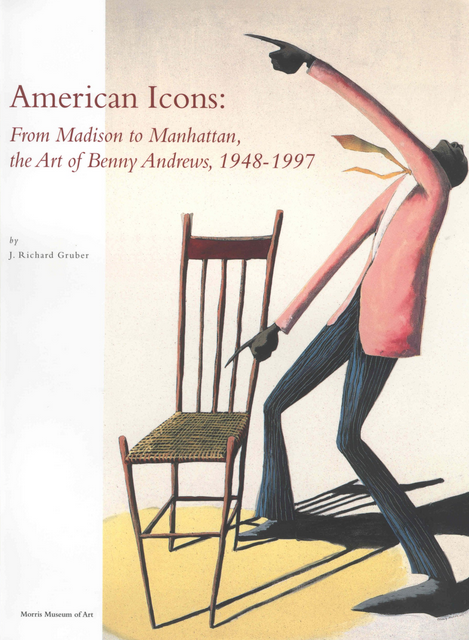
In 1997, the Morris Museum of Art in Augusta, Georgia mounted “American Icons: From Madison to Manhattan, the Art of Benny Andrews, 1948-1997. This is the cover image for the exhibition’s catalog.
Nearly 50 years after the BECC presented its list of demands, some historians and critics suggest that the changes within the museum world have been more evolutionary than revolutionary, as far as people of color are concerned. Through it all African American artists–including Benny Andrews– continued to produce, show, and sell their art in African American and mainstream settings, both during and beyond the subject era.
J. Richard Gruber, author of the catalog for American Icons: From Madison to Manhattan, the Art of Benny Andrews, 1948-1997, a major retrospective of Andrews work, suggests that the artist and Queens College educator became even more well-known in the 1960s and 1970s because of his work with BECC and his published articles in the New York Times, which allowed him to share his thoughts on black art with a national audience. As Gruber states in the 1997 catalog:
By the first year of the 1970s, Benny Andrews had established his reputation not just as a significant artist but also as a spokesman, organizer and writer, as a skilled advocate for issues related to black art and artists.
Benny Andrews (1930-2006) would later place both the artists struggles and his thoughts on the nature of their progress in a larger historical context during an interview for “Colored Frames”, a visual documentary, After stating that he was “lucky enough to receive a reward for his participation” in numerous protests, Andrews reminded viewers that most participants were not as lucky, and many people (“the masses”) were never recognized for their support, although their contributions were invaluable:
It takes a lot of people to make a little thing . . . Life is like a relay race, and we were lucky that we had the bar for a while, but we got it from somebody, and we passed it on to somebody. That little stretch that we ran is just a link in a chain that goes both ways. . . You’re no alpha or omega of anything.
Based on the evidence that I have examined thus far, I am convinced that Andrews, who may not have been the “alpha or omega” of activism or Black art in 20th-century America, was one of its most creative and articulate leaders. I am looking forward to incorporating more information about Andrews and BECC in my research, writing, teaching, and community service activities in the new future.
Regennia N. Williams, PhD
Founder and Director of the RASHAD Center, Inc.
Consultant and Museum Scholar, The Edward E. Parker Museum of Art


 The RASHAD Center, Inc.