
Prof. Edward E. Parker
Regennia N. Williams, PhD
In May of 2018, I embarked upon a research journey that has allowed me to build upon several earlier oral history and writing projects, and think about my scholarship and teaching activities in ways that would have been difficult for me to imagine as recently as two years ago.
My work as the inaugural Museum Scholar for the Edward E. Parker Museum of Art has brought about this revolution in my thinking, and Prof. Edward E. Parker, the museum’s owner and founder, has expressed a desire to have his East Cleveland institution serve as a catalyst for a larger artistic “renaissance at Euclid Avenue and Rosalind Avenue,” which is just east of Cleveland’s University Circle community, a hub for cultural, artistic, and educational activities.

“After Midnight,” a painting that Prof. Parker completed during his high school years in Toledo, Ohio.
Prof. Parker–a Pittsburgh native, longtime Ohio resident, former K-12 and post-secondary art educator, and entrepreneur–discovered his love for art while attending elementary school in Toledo. He completed some of his earliest formal training in the Saturday morning children’s classes at the Toledo Museum of Art, and he continued to use his natural talents and improve his skills through high school and then undergraduate studies at Central State University.
Beginning in the late 1960s, he taught first in Toledo and then in the Cleveland Public Schools. He also went on to earn a Master’s degree at Kent State University in the early 1970s. His last full-time teaching position was at Cuyahoga Community College, where he worked for nearly 20 years on the institution’s western campus.

“Stove Pipe the Master Clown,” a 1982 drawing and the subject of a popular print by Prof. Edward E. Parker.
Prof. Parker has long combined his interests in art, education, and entrepreneurship. In 1978, he established the Snickerfritz Cultural Workshop for the Arts, and by 2014 he began to work with board members and others to lay the foundation for what is now the Edward E. Parker Museum of Art, a 501(c)(3) nonprofit entity that is home to numerous examples of his own work and works by artists from other parts of the world. In addition to the museum’s galleries, the Edward E. Parker Creative Arts Complex also houses the African Bookshelf gift shop, studio and classroom spaces, a special events center, and Prof. Parker’s personal archives.

Portrait bust of President Barack Obama by Prof Edward E. Parker.
Always a prolific artist, he has produced more than 3,000 works, including drawings, paintings, murals, and sculptures. With the announcement of his desire to support the research for a series of books for adults and children and a catalog for a major retrospective, Prof. Parker formally launched his latest educational and artistic endeavor. In addition to the book projects, “Artistic Journeys in Black: An Oral History of African American Art in Greater Cleveland” will include the first-person narratives of Prof. Parker and many of his long-time colleagues.
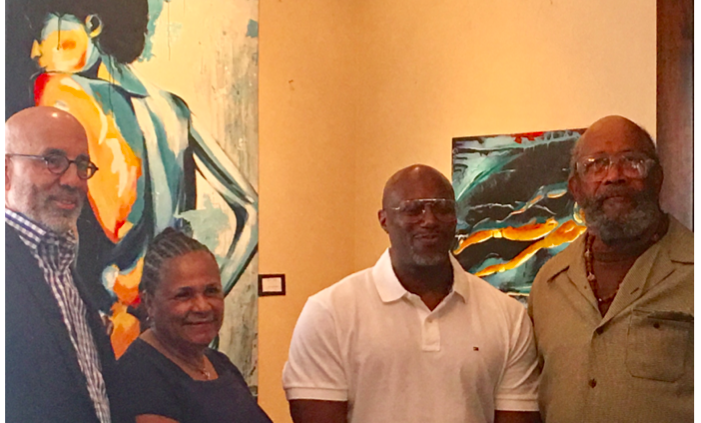
Prof. Edward E. Parker serves as Curator for Shinn House Galleries. The galleries are located at the Mount Zion Congregational Church in Cleveland’s University Circle Community. Professor Parker (right) is pictured here at the May 5, 2018 opening of a show featuring work from the Grafton Correctional Institution’s Art + Freedom Project. With him are (left to right) the Rev. Paul Hobson Sadler, Mrs. Joyce Shinn, and Mr. Eric Gardenhire, director of the Grafton Program.
As the founder and curator of the Praying Grounds Oral History Project, I was especially pleased to learn of Prof. Parker’s work with the Shinn House Galleries at Cleveland’s Mount Zion Congregational Church. As a member of Mount Zion and an artist whose works on the passion of Christ have been displayed at the church, Prof. Parker helped establish the Shinn House Gallery exhibitions and a related museum-based lecture series with the support of church leaders, patrons of the arts, and community partners in 2018.
With so many interesting and exciting things happening in the nation’s arts and humanities communities in 2019, I know that remaining focused and making significant progress on the research and writing will be a challenging. But, as members of the 400 Years of African American History Commission will remind us throughout 2019, the journeysof Black people in this part of the world have taken them through eras filled with servitude, chattel slavery, quasi-freedom, Jim Crow segregation, disfrnachisement, and, yes, evidence of real social, cultural, educational, political, and economic progress.
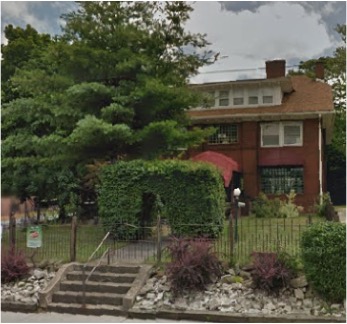
The Edward E. Parker Museum of Art is located at 13240 Euclid Avenue in East Cleveland, Ohio.
It will, therefore, be my great pleasure to spend 2019 focusing on, among other subjects, “One Black Man’s Artistic Journeys: The Life and Work of Edward E. Parker and the Legacy of the Black Arts Movement in Ohio.” This is the working title for the scholarly biography for adults, and I look forward to sharing project updates throughout the coming year. –RNW
For more information on Prof. Parker, please visit the website for The HistoryMakers®.


 The RASHAD Center, Inc.