
By Regennia N. Williams, PhD
“[Y]uh got tuh go there tuh know there. Yo’ papa and yo’ mama and nobody else can’t tell yuh and show yuh. Two things everybody’s got tuh do fuh theyselves. They got tuh go tuh God and they got tuh find out about livin fuh theyselves.” -Zora Neale Hurston, 1937
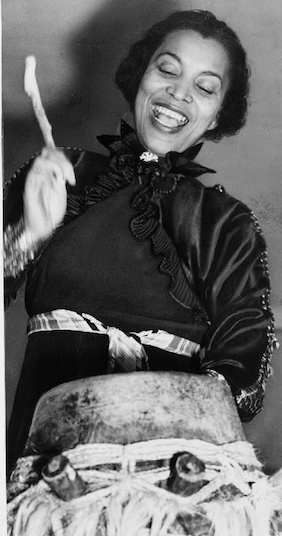
Zora Neale Hurston (1891-1960), a native of Alabama, was a folklorist, an anthropologist, an author, and a “Genius of the South.” Hurston is shown here in a 1937 image taken during a research trip to Haiti. (Zora Hurston, half-length portrait, standing, facing slightly left, beating the hountar, or mama drum. 1937. Photograph. https://www.loc.gov/item/93513271/.)
At this point in my career as a historian, I really enjoy looking back over my life and the incredible global teaching-learning-research journeys that I have taken, thanks to the Fulbright U.S. Scholar Program, the Fulbright Specialist Program, World Learning, and academic programs that promote and support professional development opportunities for college and university faculty and staff members.
Whether I am in the midst of preparing for an in-class lecture, a seminar, a public workshop, or some other work-related talk, there is, to my mind, no better way to begin an engaging presentation than with an inspiring journey-related story. The following story is one that I just can’t seem to get out of my mind, and I am sure that this has everything to do with the fact that I never want to forget it.
Nearly 40 years ago, while completing the requirements for my first college degree in Cleveland, Ohio, USA, Marjorie Witt Johnson, a social worker with Harambee Services to Children and Families; invited me to join her at a public program. On the evening of that event, with my preschool-aged son in tow, I traveled with Mrs. Johnson to a community event that would change my life forever.
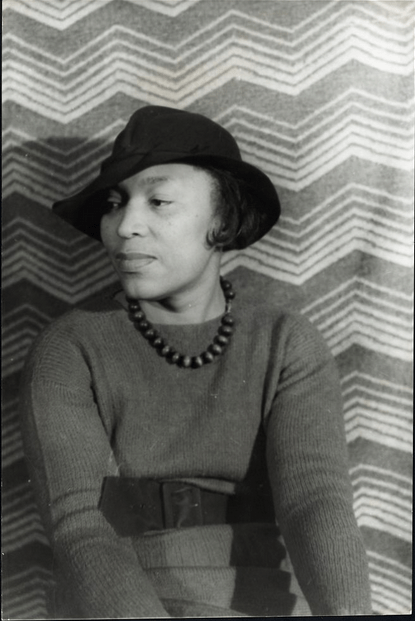
Zora Neale Hurston, 1938. (Library of Congress, Prints & Photographs Division, Carl Van Vechten Collection, [reproduction number, e.g., LC-USZ62-54231])
Before that gathering was officially adjourned, I became life-long “friends” with Zora Neale Hurston and Their Eyes Were Watching God, her 1937 novel. Back then, I had no idea that Hurston’s books would have such a lasting impact on my life and work, and I certainly could not have imagined that I would someday write books, book chapters, and articles that others would read.
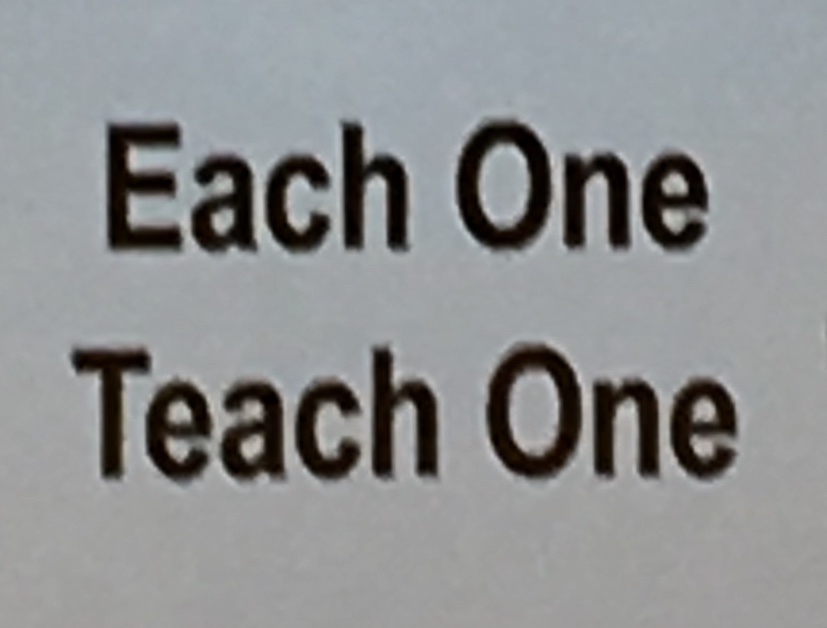
The Motto of the Congress of South African Students (COSAS).
Today, I always welcome the opportunity to read Hurston’s work, and, like the public speakers and teachers from my past, I encourage my students to do the same. No one should be surprised, therefore, to hear that, on the first day of class, I introduced learners in my summer Oral History Module at South Africa’s University of the Free State to Zora Neale Hurston and her love for the oral traditions of African peoples in diaspora.

Regennia N. Williams, PhD, Fulbright Specialist, University of the Free State, July 2019.
There are many lessons that learners the world over can glean from the life story of Zora Neale Hurston and her ability to travel throughout the United States and the Caribbean, all the while learning from the numerous African-descended peoples that she met along the way–even on her (usually) extremely limited budget. The most important lesson, perhaps, is embodied in the aphorism that she shares in the Southern Black vernacular English of Janie, the lead character in Their Eyes Were Watching God: “[Y]uh got to go there tuh know there.”
Whether they are planning to travel to the library archives and arts centers on the other side of town or classrooms and museums on the other side of the world, it is my hope that 21st-century teachers, learners, and other citizen ambassadors will continue to find opportunities to “go there,” discover the cultural treasures of other people, and share the riches of their own cultures with the rest of the world. I am convinced that Fulbright and World Learning wouldn’t have it any other way!
PLEASE NOTE: The blog site for the RASHAD Center, Inc. (https://rashadcenter.wordpress.com/) is not an official U.S. Department of State site or a site approved by Montgomery College. The views expressed on this site are entirely those of its author, Dr. Regennia N. Williams, and do not represent the views of the U.S. Department of State or any of its partner organizations.


 The RASHAD Center, Inc.