
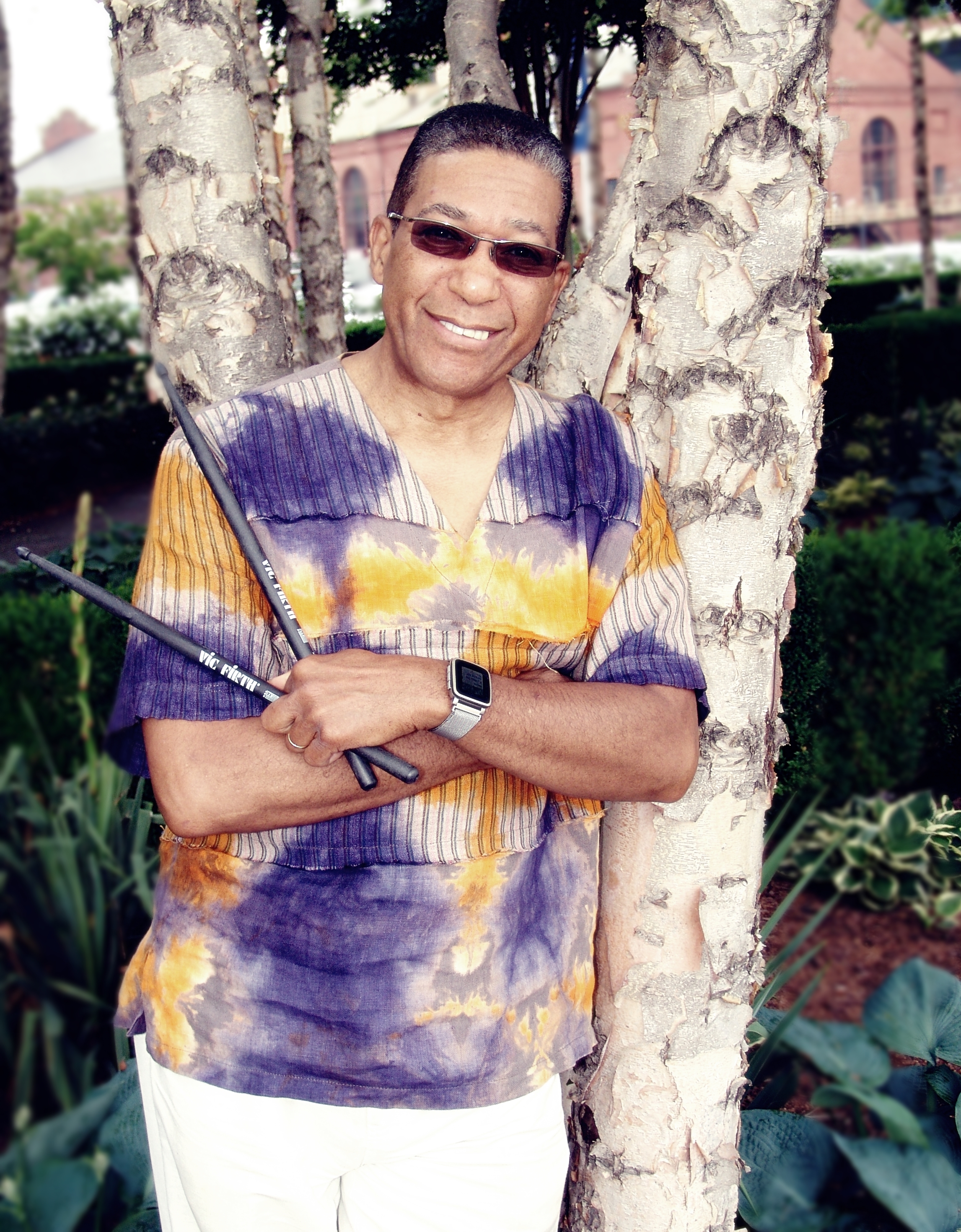
Prof. Nasar Abadey
Prof. Nasar Abadey — Pennsylvania native and award-winning master drummer, educator, and bandleader for SUPERNOVA®–discusses some of the people and places that shaped his artistic vision.
“When I was living in Buffalo, there was an area of town on the east side that had the same kind of commercial zone for jazz as exists now in Washington DC, that exists in Pittsburgh, that exists in New York. All these cities . . Because, at that time, we were segregated, we spent our money in our communities 10, 15 times before it went outside of our communities. So, to hear this music, you could just leave out of your house, walk a few blocks, and you could hear live jazz. That doesn’t exist anymore, not in the African American community.”
“When I first landed in DC, I started working with . . . there were two, the first was Yaya, who plays tenor saxophone, and a musician that I met playing in his band by the name of Brother Ah.”
“When I met Brother Ah, he called me to join his band, and I was looking forward to joining his band, or a band like his, because I was interested in really studying African music, African culture, and the African frame of mind, so to speak, so that I could frame it within my own music, so that I could discover some of myself, some of that culture in the music. So, I worked with him, maybe, five years straight.”
I started to learn that our music is a music of environment. Our music is brought from the environment to any other environment, and it is like a snowball. You can keep rolling the snowball, and it gains more snow, and it gets bigger, and bigger, and bigger. Before you know it, someone walks up on a snowball and says, “Wow, that’s a great big snowball.” They don’t think about how it got that big, they don’t think about its travels and how it got there to be a great big snowball. They don’t realize that in its roll, as it is rolling on the ground, that it is picking up snow, and snow, until it gets bigger.”
“It’s the same thing with African music and the culture in which it is allowed to exist, or creative force. It starts to glue itself together or amalgamate, so that when it gets with other snowballs, they understand each other, and they start to put what they know together—like Bird and Diz did. Diz said, when he heard Bird, ‘Oh, now I know where I belong.’ He is thinking like me, and it’s the same thing with this music.”
We become aware of the fact that we play the music that we hear in our environment. And when we get together as musicians, we start comparing notes, and we start to see that this person over here starts to play something that they heard– dog sounds, or sounds of the crickets, or sounds of the birds, like Eric Dolphy played or practiced with birds, and that’s how he got such an amazing concept of playing on the flute.”
So, I like to think that when our music came to the city, it became the environment of the city, but we’ve got to remember that it came from the blues, and the blues came out of Africa. Jazz is music that developed in America, but its foundations are rooted in Africa.”
Interviewed on April 9, 2017
By Dr. Regennia N. Williams
Life Member, Oral History Association
Founder and Director, The RASHAD Center, Inc.
Photograph by Nathaniel Rhodes
#WashingtonDCJazz
#DCLegendaryMusicians
#OralHistoryRocks


