“You’ve just got to listen to it. Listen to the music. You have to constantly listen to the music.” –Jeffrey J. “Lefthand” Neal, Drummer
Jeff “Lefthand” Neal
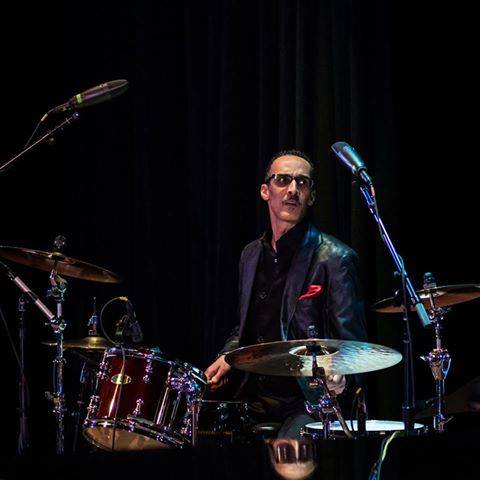
Jeffrey J. “Lefthand” Neal –a drummer, former architect, and current entrepreneur—has worked as a full-time musician for over 16 years. A native Washingtonian, he is a product of the District’s public schools. During his interview for the Washington DC Jazz Oral History Project, he described his indirect educational route to a professional career in music.
“None of my schools had any strong visual [arts] or instrumental music programs . . . I started with the DC Youth Orchestra Program, which was a free program. It had disbanded, and it is back now. . . They did it at [Calvin] Coolidge [Senior High], so we had to go to Coolidge to take the lessons . . .”
“I didn’t get into jazz until I was 40 years old, and I remember that I happened to do a play with Davey Yarborough in 1991. That’s when I met him. Davey Yarborough is the head of the Jazz Studies Program at the Duke Ellington School. I remember asking him the question, “Which jazz album should I buy?” So, I wasn’t even listening to jazz early on, I was listening to Rock . . .”
“I got to take master classes from some of the best in the business: Ed Thigpen, [Leon] Ndugu Chancler, Keith Smith, just a lot of great drummers, just listening and experiencing their master classes. Their main thing was, “You’ve just got to listen to it. Listen to the music. You have to constantly listen to the music.”
Interviewed on April 4, 2017
By Dr. Regennia N. Williams
Life Member, Oral History Association
Founder and Director, The RASHAD Center, Inc.
Photograph Courtesy of Jeffrey J. “Lefthand” Neal
Jeffrey J. “Lefthand” Neal Solos on “One Note Samba”
About Dr. Regennia N. Williams, Founder, President, and Executive Director
Dr. Regennia N. Williams is the Founder and Executive Director of The RASHAD Center, Inc., a Maryland-based non-profit educational corporation.
Williams holds a PhD in Social History and Policy from Case Western Reserve University in Cleveland, Ohio. A native Clevelander and a four-time alumna of Cleveland State University, information on RASHAD's “Praying Grounds, African American Faith Communities: A Documentary and Oral History” project is now available online at www.ClevelandMemory.org/pray/, a site that is maintained by CSU's Library Special Collections, home of the Praying Grounds manuscript collections. Praying Grounds was the primary inspiration for the launching of the Initiative for the Study of Religion and Spirituality in the History of Africa and the Diaspora (RASHAD) at CSU, and links to RASHAD's scholarly journal and newsletter are also available on the Praying Grounds site. On April 28, 2020, the RASHAD Center, Inc. became a tax-exempt 501(c)(3) nonprofit organization.
In 2010, Dr. Williams was a Visiting Fulbright Scholar at Nigeria’s Obafemi Awolowo University, where she taught history and directed a RASHAD-related oral history project that focused on the role of religion in recent Nigerian social history. Other research-related travels have taken her to Canada, China, France, South Africa, and Austria.
In 2013, she conceived and produced “Come Sunday @ 70: The Place of Duke Ellington’s Sacred Jazz in World History and Culture, c. 1943-2013,” a project that included scholarly presentations and performing arts activities. From September 1993 until May 2015, she was a faculty member in the Department of History at Cleveland State University. She served as a Fulbright Specialist at South Africa's University of the Free State in the summer of 2019, and completed a short-term faculty residency at Howard University in the fall of 2019. She is based in Cleveland, Ohio.
As a public scholar, her current research projects focus on African American history and culture, especially as it relates to music, religion, and spirituality. She is a member of the Oral History Association, the Western Reserve Historical Society, and the National Museum of African American History and Culture.