“My story begins, as a musician, at the Music Center / Sitar Arts Center in Adams Morgan.”
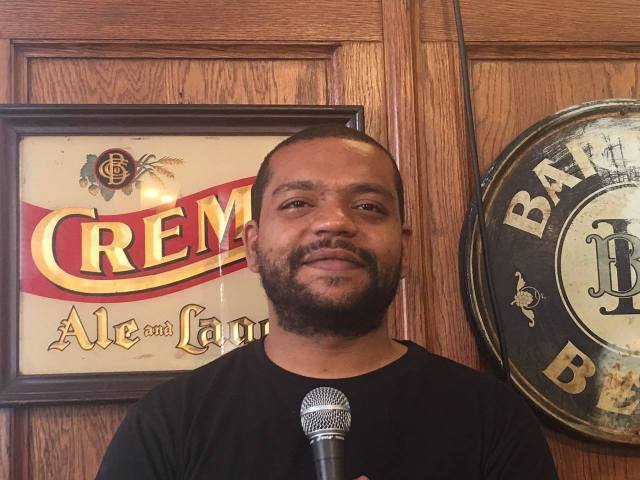
Herbert James Scott
Herbert James Scott–saxophonist, leader of the Herb Scott Quartet, arts activist, and co-founder and Executive Director of the Capitol Hill Jazz Foundation—shared his oral history narrative with me at Mr. Henry’s Restaurant on Pennsylvania Avenue. For Scott, his late father Clayton Scott and teachers in the Metro DC Area and in Michigan were instrumental in shaping his vision as a performing artist.
“My dad was there to help me buy my first saxophone. He took me to my first live performance, where I saw the Smithsonian Jazz Masterworks Orchestra at the Lincoln Theatre . . .”
“My story begins, as a musician, at the Music Center / Sitar Arts Center in Adams Morgan. The founder is a woman named Rhonda Buckley, who is from Michigan. She taught in Michigan and ended up coming to DC. Rhonda Buckley, who was my original mentor—and still is today—was very influential in my beginning at the Sitar Center and at the Levine School of Music. She also urged me to go study at the Duke Ellington School of the Arts.”
“I had met Davey Yarborough at the Music Center just prior to enrolling at Ellington [where he taught]. Davey Yarborough was and is still very influential in my life as a saxophonist and a musician.”
“When I went to Michigan State University, there were two people: Rodney Whitaker, the great bassist and [Director of Jazz Studies], and Diego Rivera, a saxophonist who was my professor. I spent a lot of time with them, and they, too, have been very influential in my career.”
Interviewed on June 14, 2017
By Dr. Regennia N. Williams
Photograph by Dr. Regennia N. Williams
For more information on the Capitol Hill Jazz Foundation, visit

About Dr. Regennia N. Williams, Founder, President, and Executive Director
Dr. Regennia N. Williams is the Founder and Executive Director of The RASHAD Center, Inc., a Maryland-based non-profit educational corporation.
Williams holds a PhD in Social History and Policy from Case Western Reserve University in Cleveland, Ohio. A native Clevelander and a four-time alumna of Cleveland State University, information on RASHAD's “Praying Grounds, African American Faith Communities: A Documentary and Oral History” project is now available online at www.ClevelandMemory.org/pray/, a site that is maintained by CSU's Library Special Collections, home of the Praying Grounds manuscript collections. Praying Grounds was the primary inspiration for the launching of the Initiative for the Study of Religion and Spirituality in the History of Africa and the Diaspora (RASHAD) at CSU, and links to RASHAD's scholarly journal and newsletter are also available on the Praying Grounds site. On April 28, 2020, the RASHAD Center, Inc. became a tax-exempt 501(c)(3) nonprofit organization.
In 2010, Dr. Williams was a Visiting Fulbright Scholar at Nigeria’s Obafemi Awolowo University, where she taught history and directed a RASHAD-related oral history project that focused on the role of religion in recent Nigerian social history. Other research-related travels have taken her to Canada, China, France, South Africa, and Austria.
In 2013, she conceived and produced “Come Sunday @ 70: The Place of Duke Ellington’s Sacred Jazz in World History and Culture, c. 1943-2013,” a project that included scholarly presentations and performing arts activities. From September 1993 until May 2015, she was a faculty member in the Department of History at Cleveland State University. She served as a Fulbright Specialist at South Africa's University of the Free State in the summer of 2019, and completed a short-term faculty residency at Howard University in the fall of 2019. She is based in Cleveland, Ohio.
As a public scholar, her current research projects focus on African American history and culture, especially as it relates to music, religion, and spirituality. She is a member of the Oral History Association, the Western Reserve Historical Society, and the National Museum of African American History and Culture.



 The RASHAD Center, Inc.